Guaranteed human oversight
aiacto is not a high-risk AI system: it falls under the transparency obligations of Article 50. No automated decision impacting the end user.
AI Assistant
Contextual AI with cross-section memory
Document generation
Annex IV compliant text generated by AI
Diagnostic
Automatic classification of your system
Versioning
Full traceability of your project changes
Multi-client
Multi-client management for agencies
PDF Export
Professional PDFs ready for audit
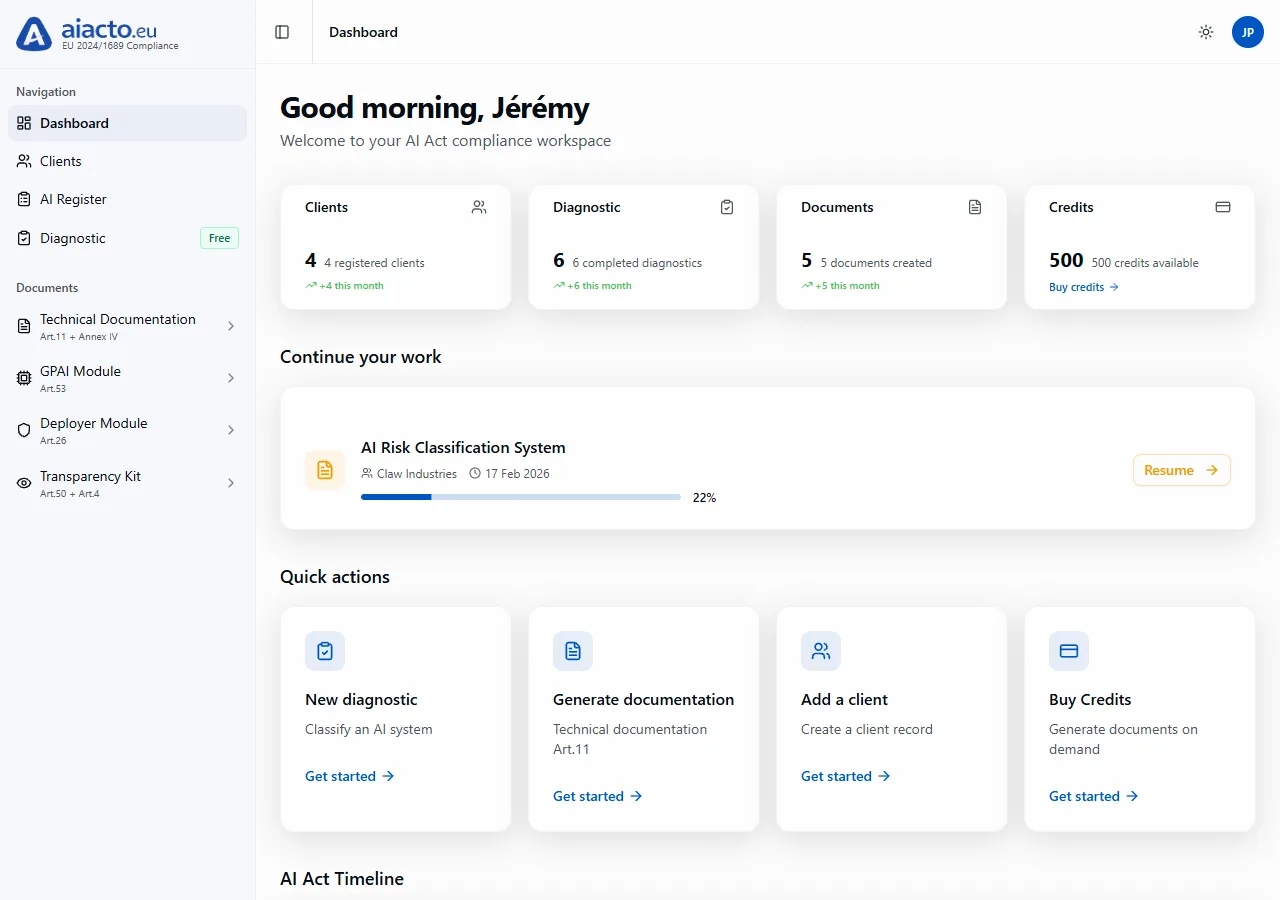
aiacto helps AI system providers and deployers identify their obligations and produce regulatory documentation in one traceable, audit-ready workflow.
European Regulation 2024/1689 imposes a cascade of obligations, including technical documentation, human oversight, risk management and transparency, with penalties of up to 7% of global turnover.
Compliance teams have fewer than 14 months to structure their response before the "high-risk" phase of December 2027.
Read our analysis of the regulationEach module produces a defensible deliverable. Reasoned diagnostic, Article 11 documentation, Article 26 register. Reviewed by your team before sign-off.
Identify the risk level, regulatory role (provider, deployer, importer, distributor) and the full list of your obligations in 3 minutes.
Draft the 14 sections of Annex IV with an assistant that proposes and you validate. Every paragraph is referenced to its source article.
For DPOs and consultancies: centralise the register of AI systems, the history of diagnostics and client validations in a single workspace.
From system classification to the final audit file, every deliverable is produced in the order expected by supervisory authorities.
Is the system prohibited, high-risk, limited-transparency or minimal? The guided diagnostic decides in 12 structured questions.
Annex III · Article 6For each high-risk system, produce the 14 sections of Annex IV with the assistant. You validate every paragraph.
Article 11Send a secure link to your external reviewer. They comment, approve or request changes, without creating an account.
Article 14Every version is timestamped and kept for 10 years. PDF export, Article 26 register and audit trail ready to transmit.
Article 12 · 18The regulation does not treat all actors in the AI chain the same way. Identifying your role, and that of your partners, is the first step of any compliance work.
Review obligations by article"Places on the market or puts into service an AI system in the Union, whether for payment or free of charge."
"Uses an AI system in the course of a professional activity, under its own authority."
"Places on the market an AI system bearing the name of an entity established outside the Union."
"Makes an AI system available without modifying its essential properties."
Sovereign hosting, end-to-end encryption, immutable logging and full transparency on the AI models used. Our infrastructure meets the strictest requirements of regulated sectors.
For a European retail group, structuring documentation for 23 AI systems including 9 high-risk ones takes around four months on aiacto, versus two years in an external consultancy, for a budget six times lower.
Regulation (EU) 2024/1689 applies in successive stages. Article 50 has applied since 2 August 2026.
AI systems with unacceptable risk are prohibited. Mandatory team training.
General-purpose AI models: documentation, transparency on training.
Transparency obligations for generated content and systems interacting with persons.
Full application to high-risk systems listed in Annex III of the Regulation.
Extension to AI systems embedded in products already covered by sectoral legislation.
Prices in euros. VAT not applicable — art. 293 B of the French General Tax Code. Monthly payment with no commitment. Cancel any time.
To evaluate the platform and run a first diagnostic.
For providers of AI systems.
For providers of general-purpose AI models.
Multi-client, SSO, SLA and dedicated support.
One-time packs, no subscription. Each pack covers one AI system.
Using AI tools in your business? Document your teams' AI training (Article 4) and keep a register of your systems.
Chatbot or AI-generated content? Information notice for affected persons (Article 50), training plan (Article 4) and systems register.
Still a question without an answer? Our team replies within 24 working hours.
Three minutes for the diagnostic. One free credit on sign-up. No credit card. Real-time response.
Start the free diagnostic