AI Act Technical Documentation Annex IV: A guide to preparing your compliance file.
Since 2 August 2026, providers of high-risk AI systems must prepare technical documentation compliant with Annex IV of Regulation (EU) 2024/1689. This guide explains the regulatory requirements and offers a methodology to transform these obligations into verifiable technical artefacts.

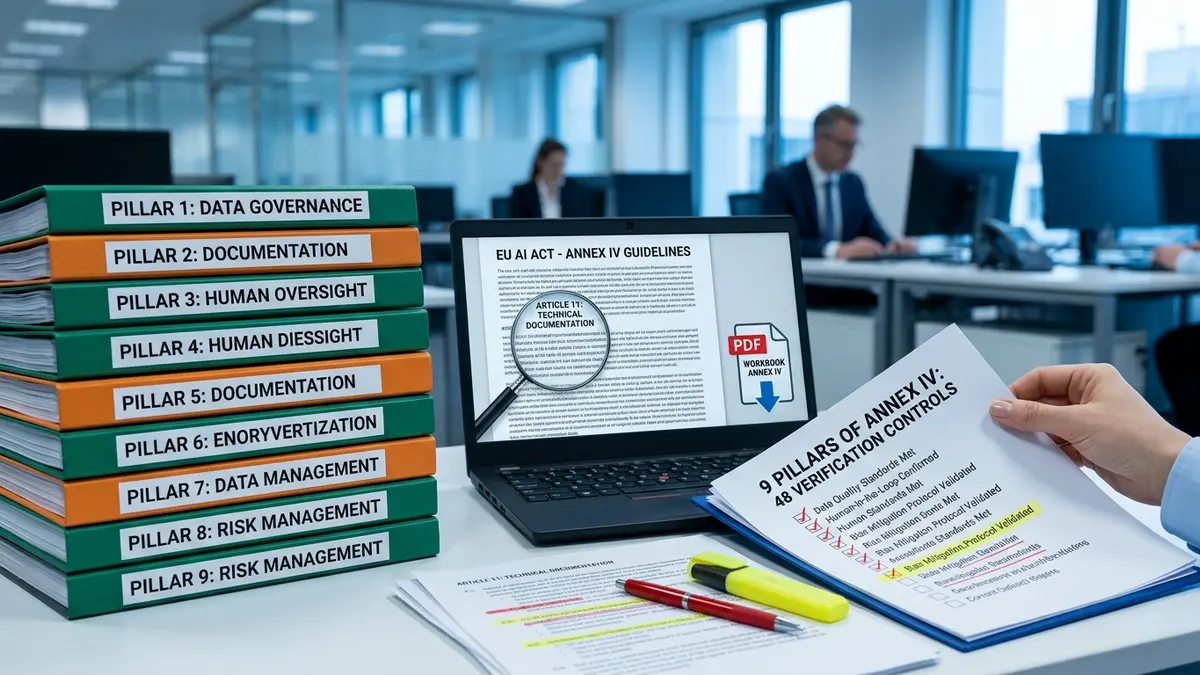
Why technical documentation is the critical point of compliance control
Annex IV of Regulation (EU) 2024/1689 is not merely an administrative formality. It constitutes the cornerstone of compliance control for high-risk AI systems.
Supervisory authorities, such as the AI Office or the CNIL, will rely on this file to assess the system's compliance. An incomplete or poorly structured file may result in fines of up to €35 million or 7% of global turnover, in accordance with Article 99 of the AI Act.
The technical documentation must demonstrate that the system complies with the requirements of Articles 8 to 15 of the AI Act. It must be updated throughout the system's lifecycle and be available for inspection for ten years after placing on the market.
The 9 pillars of Annex IV explained
Annex IV lists nine categories of information to be documented. Here is a detailed analysis of each pillar, along with the expected technical artefacts.
1. General description of the AI system
This section must provide an overview of the system, including:
- Name and version of the system
- Description of the main functionalities
- High-risk category (Annex III)
- Overall technical architecture
- Data flow diagram
Expected artefact: System identity sheet (maximum 1 page).
2. Detailed description of the system components and development process
This part must cover:
- Description of software and hardware components
- Explanation of the algorithms used
- Development methodology (e.g., Agile, Waterfall)
- Testing and validation phases
Expected artefact: Model card and datasheet (based on standards such as Model Cards for Model Reporting and Datasheets for Datasets).
3. Detailed information on training, validation, and test data
The requirements include:
- Origin and quality of the data
- Data collection and cleaning process
- Description of potential biases and mitigation measures
- Data performance metrics (e.g., representativeness, balance)
Expected artefact: Comprehensive datasheet with a register of data sources.
4. Risk assessment and mitigation measures
This section must document:
- Risk assessment methodology (e.g., FRIA)
- Identified risks and their severity
- Mitigation measures implemented
- Evidence of the effectiveness of the measures
Expected artefact: Risk matrix and mitigation plan.
5. Description of transparency and user information measures
The elements to document include:
- User instructions and warnings
- Explanations of the system's limitations
- User feedback mechanisms
Expected artefact: User manual and transparency sheet.
6. Description of human oversight measures
This part must include:
- Roles and responsibilities of human operators
- Supervision and intervention procedures
- Tools provided for oversight
Expected artefact: Human oversight procedure and intervention log.
7. Description of robustness, accuracy, and cybersecurity measures
The requirements cover:
- Performance metrics (e.g., accuracy, recall, F1-score)
- Robustness tests (e.g., adversarial testing)
- Cybersecurity measures (e.g., encryption, access control)
Expected artefact: Technical test report and cybersecurity audit.
8. Description of the post-market monitoring system
This section must detail:
- Continuous monitoring process
- Feedback collection mechanisms
- Update and maintenance procedures
- Incident management plan
Expected artefact: Post-market monitoring plan and incident log.
9. Register of significant modifications
The information to be recorded includes:
- Description of modifications
- Justification for changes
- Impact on compliance
- Evidence of risk reassessment
Expected artefact: Modification register with versioning.
3 common pitfalls to avoid in technical documentation
Compliant technical documentation is not just about ticking boxes. Here are the frequent mistakes that can compromise your compliance.
1. Relying on an average metric score
The AI Act requires a detailed analysis of system performance, including:
- Disaggregation of metrics by subgroups (e.g., gender, age, origin)
- Analysis of errors and their impacts
- Performance evaluation under real-world conditions
An overall accuracy or recall score is insufficient. Performance must be documented for each relevant group, and discrepancies must be explained.
2. Overlooking data traceability
Data traceability is a cornerstone of compliance. Authorities will require:
- A register of data sources
- Proof of consent or legal basis for each dataset
- A history of data transformations
Without this traceability, it is impossible to demonstrate compliance with the GDPR or Annex IV.
3. Neglecting human oversight
The AI Act mandates human oversight measures for high-risk systems. This includes:
- Clear definition of roles and responsibilities
- Training of human operators
- Documentation of intervention procedures
- A log of human actions
An AI system cannot operate in full autonomy. The documentation must prove that human oversight mechanisms are in place and operational.
How to turn legal text into an operational action plan
Moving from regulatory requirements to technical deliverables requires a structured methodology. Here is how to proceed.
1. Assign roles and responsibilities
Technical documentation involves several stakeholders:
| Role | Responsibilities |
|---|---|
| Tech Lead / CTO | Technical supervision, artefact validation |
| Data Scientist | Drafting datasheets and model cards |
| DPO / Compliance Officer | Verification of GDPR and AI Act compliance |
| Product Owner | Documentation of functionalities and limitations |
| Security Officer | Documentation of cybersecurity measures |
2. Create a register of evidence
Each requirement of Annex IV must be linked to tangible evidence. Here is an example structure:
| Annex IV Requirement | Expected Evidence | Responsible | Status |
|---|---|---|---|
| Description of training data | Datasheet + register of sources | Data Scientist | ✓ Validated / ⚠ In progress / ❌ Not started |
| Risk assessment | Risk matrix + mitigation plan | DPO | ✓ Validated / ⚠ In progress / ❌ Not started |
| Cybersecurity measures | Audit report + security policies | Security Officer | ✓ Validated / ⚠ In progress / ❌ Not started |
3. Prioritise actions with a risk matrix
Not all Annex IV requirements have the same level of criticality. Use a risk matrix to prioritise:
| Regulatory Impact | Probability of Inspection | Priority |
|---|---|---|
| High (fine > €10M) | High (likely inspection) | P1 - Urgent |
| Medium (fine €5-10M) | Medium (possible inspection) | P2 - Important |
| Low (fine < €5M) | Low (unlikely inspection) | P3 - Standard |
4. Automate evidence collection
Technical documentation must be maintained throughout the system's lifecycle. To achieve this:
- Integrate versioning tools (e.g., Git, DVC) to track modifications
- Use MLOps platforms (e.g., MLflow, Weights & Biases) to document experiments
- Automate report generation (e.g., Python scripts for datasheets)
Resources to start your technical documentation
To help you prepare your compliance file, AiActo provides a comprehensive and free Annex IV Workbook.
Annex IV Workbook - 23 pages to get started
This interactive workbook guides you step-by-step in preparing your technical file. It includes:
- 48 operational control points
- System identity sheet
- Readiness dashboard
- Register of evidence
- Prioritised action plan (P1/P2/P3)
- Final validation page with signature
Available in English, French, German, and Spanish.
To download the Annex IV Workbook, visit the AiActo Document Generation page or use the direct link: PDF Download EN.
Frequently asked questions
Answers to technical and operational questions about AI Act technical documentation.
Article 11 of the AI Act imposes a general obligation for technical documentation for high-risk AI systems. It specifies that this documentation must be retained for ten years and made available to the competent authorities.
Annex IV details the specific content of this documentation. It lists the nine categories of information to be included, such as the description of data, robustness measures, or the post-market monitoring system.
Annex IV applies only to AI systems classified as high-risk under Article 6 and Annex III of the AI Act.
However, minimal technical documentation is recommended for all AI systems, even those with limited risk. This facilitates demonstrating compliance with other obligations, such as those under Article 50 on transparency.
Documenting biases should include:
- An analysis of subgroups represented in the data (e.g., gender, age, origin)
- Performance metrics disaggregated by subgroup
- Performance discrepancies between subgroups and their justification
- Mitigation measures implemented (e.g., data rebalancing, algorithm adjustments)
Use tools such as Fairlearn to analyse and document biases.
Several tools can help automate technical documentation:
- MLflow: for tracking experiments and models
- Weights & Biases: for documenting runs and artefacts
- DVC: for versioning data and models
- Fairlearn: for analysing and documenting biases
- Great Expectations: for validating and documenting data
These tools can automatically generate parts of the documentation, such as datasheets or model cards.
The AI Act requires continuous monitoring of high-risk AI systems after placing on the market. Key steps include:
- Monitoring: Implement a monitoring system to detect performance drift or incidents.
- Assessment: Reassess risks with each significant modification to the system.
- Documentation: Record all modifications in the modification register (Annex IV, point 9).
- Notification: Report serious incidents to the competent authorities within 72 hours.
Use MLOps tools to automate parts of this monitoring, such as detecting performance drift.