AI Act vs GDPR: Complete Comparison of Obligations for Businesses
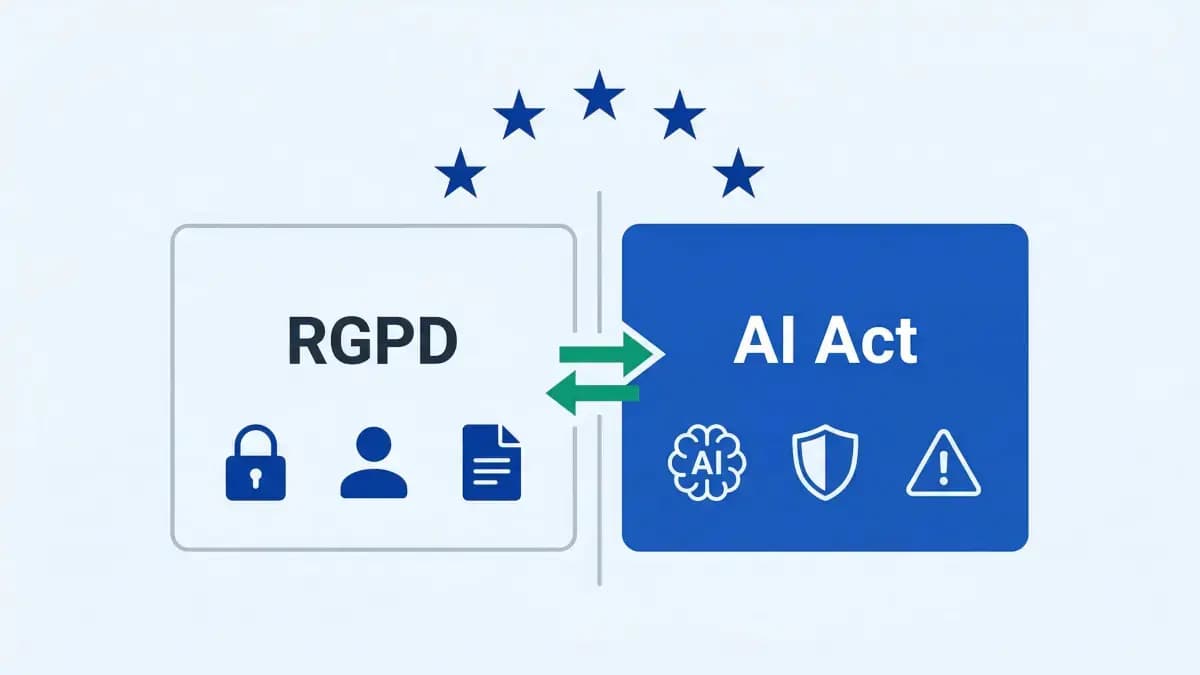
Key takeaways
- Two regulations, two distinct objects: the GDPR protects individuals' personal data rights; the AI Act governs AI systems by risk level. They don't replace each other.
- Frequent simultaneous application: any AI system that processes personal data is subject to both regulations at once. This covers the majority of business AI tools.
- Major overlap areas: training data governance (Art. 10 AI Act + Art. 5/6 GDPR), impact assessments (FRIA + DPIA), transparency (Art. 50 AI Act + Art. 13/14 GDPR)
- Different penalty levels: GDPR up to €20M or 4% of global turnover; AI Act up to €35M or 7% for prohibited practices, €15M or 3% for high-risk violations
- Distinct authorities: data protection authorities supervise GDPR; national AI Act authorities (e.g. DGCCRF in France) supervise the AI Act, with DPAs for personal data aspects
- Coordination possible: both compliance programmes can be run jointly to avoid duplication, particularly on documentation and impact assessments
Since the GDPR came into force in 2018, European organisations have learned to govern personal data processing. With the AI Act (Regulation EU 2024/1689), a new regulatory framework has arrived - but it doesn't replace the GDPR. It stacks on top of it.
For legal and compliance teams, this stacking creates legitimate confusion: do I need two separate impact assessments? Two separate registers? Does my GDPR documentation cover the AI Act too? This guide answers those questions with a structured comparison of both regulations.
The Essentials at a Glance
Before going into detail, here are the fundamental differences between the two regulations:
- GDPR's purpose: protect individuals' fundamental rights regarding the processing of their personal data
- AI Act's purpose: govern the development and use of AI systems using a risk-based approach
- GDPR trigger: processing of personal data of individuals in the EU
- AI Act trigger: developing, placing on the market, or using an AI system in the EU
- GDPR entered into force: May 2018
- AI Act entered into force: August 2024 (progressive application through 2027)
An AI system can perfectly well process no personal data - and thus fall only under the AI Act. Conversely, a personal data processing operation without any AI component falls only under the GDPR. But in practice, the vast majority of business AI systems process personal data: they are subject to both regulations simultaneously.
The Actors Involved: Who Does What?
The two regulations use different terminology to describe the actors:
Under the GDPR
- Controller: determines the purposes and means of personal data processing
- Processor: processes data on behalf of the controller, governed by a DPA contract
- Data Protection Officer (DPO): mandatory in certain cases, advises and monitors compliance
Under the AI Act
- Provider: develops and places an AI system on the market
- Deployer: uses an AI system in the course of a professional activity
- Importer / Distributor: intervenes in the system's supply chain
The same actor can hold multiple roles simultaneously. A company developing an AI-powered HR software is both an AI Act provider and a GDPR controller - and potentially a GDPR processor if it processes employee data on behalf of its clients.
Comparative Table of Main Obligations
Documentation and Registers
- GDPR (Art. 30): records of processing activities, maintained by controller and processor. Must cover purpose, data categories, recipients, retention periods.
- AI Act (Art. 11 + Annex IV): technical documentation for high-risk system providers. 9 sections covering architecture, training data, risk management, performance metrics, post-market monitoring.
- Overlap: an AI system processing personal data must appear in both records. AI Act documentation can integrate GDPR elements to avoid duplication.
Impact Assessments
- GDPR (Art. 35) - DPIA: mandatory when processing is likely to result in high risk to individuals' rights and freedoms. Triggered notably by profiling, systematic monitoring or processing of sensitive data.
- AI Act (Art. 27) - FRIA: mandatory for public bodies, essential service operators and education institutions deploying high-risk AI systems. Covers all fundamental rights, not just personal data.
- Overlap: both assessments can be conducted jointly. Their content will overlap on data protection and non-discrimination. The AI Act explicitly encourages this coordination.
Transparency and Individual Information
- GDPR (Art. 13/14): inform individuals about data processing - controller identity, purpose, legal basis, retention period, rights. Information at the time of collection or within a reasonable period.
- AI Act (Art. 50): inform individuals that they are interacting with an AI (chatbots), that content is AI-generated (deepfakes), or that they are subject to an emotion recognition system.
- Overlap: for an AI system processing personal data, both transparency obligations must be met. They can be integrated into a single information document, provided it covers both regulations' requirements.
Data Governance
- GDPR (Art. 5/6/9): data must be collected for specified purposes, on an identified legal basis, in minimal quantities. Sensitive data requires enhanced safeguards.
- AI Act (Art. 10): training, validation and test datasets for high-risk systems must be relevant, representative, free of errors and complete. Bias detection and correction procedures are required.
- Major overlap: if the training dataset contains personal data, both regulations apply simultaneously. A GDPR legal basis must be identified for training, and AI Act quality requirements must be met.
Key point: the Digital Omnibus proposes allowing the processing of sensitive data to detect and correct biases in AI systems, under strict conditions. This is a development that creates an explicit bridge between the two regulations.
Individual Rights
- GDPR: right of access, rectification, erasure, restriction, portability, objection. Right not to be subject to automated decision-making without human intervention (Art. 22).
- AI Act: right to information on AI system use (Art. 50), right to human oversight of decisions influenced by high-risk systems (Art. 14/26), right to explanation of automated decisions in certain contexts.
- Interaction: the right not to be subject to automated decision-making (GDPR Art. 22) and AI Act human oversight obligations (Art. 14) reinforce each other. An organisation cannot invoke the AI Act to bypass GDPR Art. 22.
Penalties
- GDPR: up to €10M or 2% of global turnover for organisational obligation violations; up to €20M or 4% for fundamental rights violations.
- AI Act: up to €35M or 7% of global turnover for prohibited practices (Art. 5); up to €15M or 3% for high-risk obligation violations; up to €7.5M or 1% for inaccurate information.
- Cumulation possible: the same violation can result in penalties under both regulations. An AI system processing personal data illegally while also violating AI Act obligations is subject to sanctions from both sides.
Competent Authorities
The two regulations are not supervised by the same authorities:
- GDPR: national data protection authorities (DPAs). In France: CNIL. In Germany: state-level DPAs + Federal Commissioner. In Spain: AEPD. In Ireland: DPC.
- AI Act: national competent authorities vary by country. In France: DGCCRF as single point of contact, with CNIL for personal data aspects of AI systems. In Germany: Bundesnetzagentur. In Spain: AESIA.
- Coordination: DPAs have competence over both regulations when an AI system processes personal data. They are a central interlocutor for cross-compliance.
How to Manage Both Compliances Without Duplication
- Map first: for each AI system or tool, determine whether it processes personal data. If yes, both regulations apply. If not, only the AI Act applies.
- Merge registers where possible: your GDPR register can include an "AI Act classification" column for AI-involving processing. Avoid two separate registers for the same systems.
- Conduct a single joint impact assessment: if both a DPIA (GDPR) and FRIA (AI Act) are required for the same system, conduct them jointly. Sections overlap on data, non-discrimination and fundamental rights.
- Unify information notices: your privacy policy can integrate the information required by AI Act Art. 50 (AI use, chatbots, deepfakes) without creating a separate document.
- Coordinate DPO and AI compliance function: the AI Act creates no DPO equivalent, but the DPO has a natural role wherever AI systems process personal data. Clarify who leads what before August 2026.
The free AiActo diagnostic helps you classify your AI systems and identify applicable AI Act obligations - complementing your existing GDPR compliance, not replacing it.
Frequently Asked Questions
Does the AI Act replace the GDPR for AI systems?
No. Both regulations coexist and apply in a complementary way. The AI Act governs AI systems by risk level. The GDPR protects personal data. If an AI system processes personal data - which is common - both apply simultaneously. The AI Act contains no provision exempting organisations from the GDPR.
Do you need two separate impact assessments - a DPIA and a FRIA?
Not necessarily. If both are required for the same system, they can be conducted jointly in a single document, provided the content covers each regulation's requirements. The FRIA has a broader scope (all fundamental rights); the DPIA focuses on personal data. The intersection is significant, particularly on non-discrimination and privacy.
Should the DPO also handle AI Act compliance?
The AI Act creates no obligation to appoint a DPO equivalent. But the DPO has a natural role on AI systems that process personal data - which covers most business cases. Some organisations create an "AI Compliance Officer" role working alongside the DPO. The important thing is clarifying who leads what before August 2026.
Does the GDPR legal basis also cover AI model training?
Not automatically. Using personal data to train an AI model is a separate processing activity requiring its own GDPR legal basis. The Digital Omnibus proposes introducing legitimate interest as a possible legal basis for training, under conditions. But under current law, a specific legal basis must be identified for each training processing activity.
Can GDPR and AI Act penalties be cumulated?
Yes. The same violation can be sanctioned under both regulations by different authorities. An AI system collecting personal data without a valid legal basis (GDPR violation) and failing to meet Article 50 transparency obligations (AI Act violation) is subject to penalties from both sides. Each regulation's penalty caps apply independently.
The AI Act and GDPR are not rivals - they are complementary. One regulates what you do with data, the other regulates what you do with the intelligent systems that process it. For organisations, the key is to avoid treating these two compliance programmes as separate silos: a shared mapping, coordinated assessments and unified governance are more effective than two parallel programmes. Visit our AI Act glossary to master the key definitions of the regulation.