AI Continent Action Plan: What Europe's €200bn AI Strategy Changes for Your Compliance
Key takeaways
- €200 billion mobilised: the AI Continent Action Plan aims to make Europe a global AI leader, with massive investment in infrastructure, data and skills
- AI Act Service Desk launched: the Commission has created an official AI Act compliance assistance service, accessible to all businesses - a strong signal that regulatory complexity is acknowledged at the highest level
- Regulatory sandboxes operational: each member state must set up at least one national AI regulatory sandbox by August 2026, allowing innovative systems to be tested in a supervised framework before deployment
- Simplification recognised but limited: tech lobbies expected more regulatory simplification - the Commission held firm, keeping the AI Act's fundamental obligations intact
- Guidelines incoming: guidance on transparency, high-risk systems and AI Act/GDPR interaction is expected in Q2 2026
- The business angle: AI Act compliance is increasingly an alignment with Europe's industrial strategy - a growing commercial argument in public and institutional markets
On April 9, 2026, the European Commission published the one-year progress report on its "AI Continent Action Plan" - the strategic plan to make the European Union a global artificial intelligence leader. One year on, 19 AI factories are deployed, gigafactories are advancing, and crucially: an official AI Act compliance assistance tool is now live.
For businesses preparing their compliance before August 2026, this plan is not merely a political announcement. It contains concrete measures that reshape the regulatory environment - and some that directly ease your compliance journey.
The 5 Pillars and Their Link to the AI Act
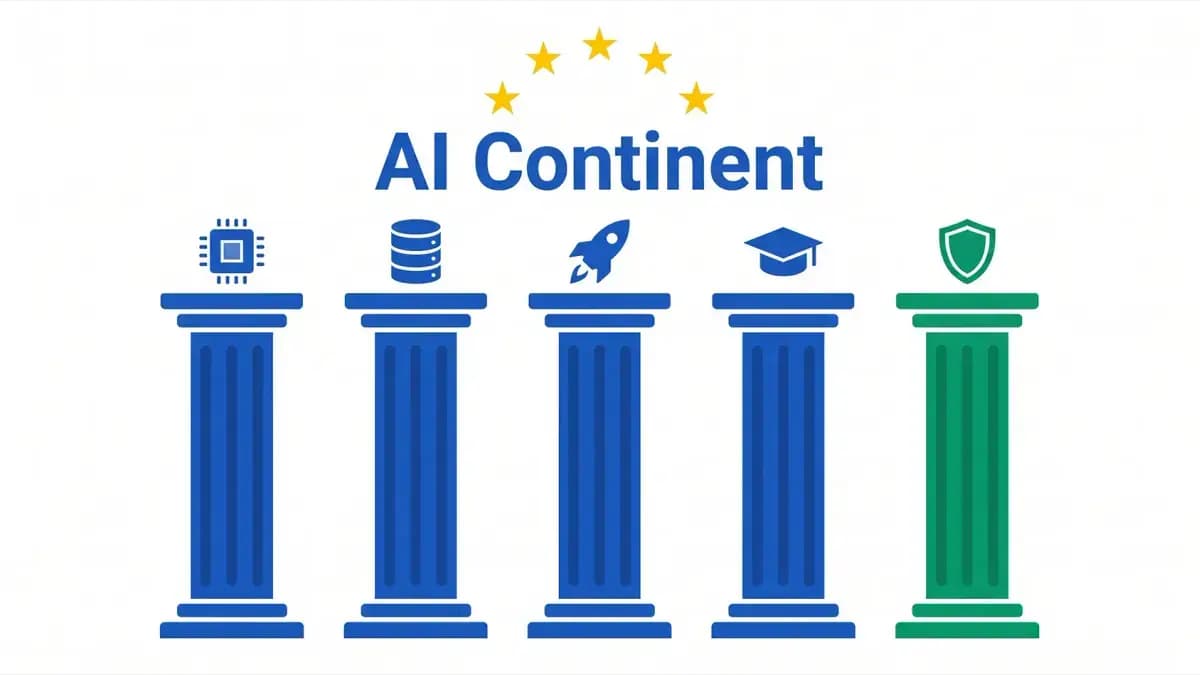
The AI Continent Action Plan is structured around five axes. Each has direct or indirect implications for AI Act compliance:
1. Large-scale computing infrastructure
Europe is building its "AI Factories" and "AI Gigafactories" - infrastructure combining supercomputers, data and expertise to train complex AI models. As of April 9, 2026, 19 AI factories are deployed across Europe's leading supercomputers. AI Act link: providers developing models on this infrastructure benefit from a European framework that simplifies training data documentation under Article 10 and GPAI obligations under Article 53.
2. Access to quality data
The Commission launched a Data Union Strategy to harmonise data access and create "Data Labs" linked to European sectoral data spaces. AI Act link: Article 10 requires training data for high-risk systems to be relevant, representative and bias-free. European Data Labs are designed to provide exactly this type of compliant datasets.
3. AI adoption in strategic sectors
The "Apply AI" strategy launched in October 2025 aims to accelerate AI adoption in industry, health, education and public services, with a focus on SMEs. AI Act link: the sectors targeted by Apply AI correspond precisely to the high-risk domains of Annex III. Entering these sectors with an AI Act compliance approach is no longer a barrier - it's becoming a condition for accessing European funding and markets.
4. AI skills and talent
Article 4 of the AI Act imposes an AI literacy obligation on providers and deployers. The plan provides an AI Skills Academy and training programmes - direct support for meeting this obligation.
5. AI Act compliance simplification
The most directly useful pillar for businesses. To facilitate AI Act implementation, the Commission has launched an AI Act Service Desk, an online platform providing access to information and guidance on the regulatory framework.
The AI Act Service Desk: An Official Compliance Tool
This is the plan's most concrete measure for businesses. The AI Act Service Desk acts as a central information hub for AI Act matters, where stakeholders can ask for help and receive tailored responses.
The Service Desk is accessible at ai-act-service-desk.ec.europa.eu. It covers definitions of roles, obligations by risk level and sector, interaction with other regulations (GDPR, DSA), and GPAI obligations for model providers.
If even the European Commission creates a dedicated AI Act compliance assistance service, it means the complexity is real. For businesses, the challenge isn't navigating this alone - it's finding the right tools.
Regulatory Sandboxes: Test Before You Deploy
Article 57 of the AI Act requires each member state to set up at least one national AI regulatory sandbox by August 2, 2026. These allow companies to develop, test and validate innovative AI systems in a supervised framework before market placement.
This is particularly useful for SMEs developing high-risk systems who want to validate compliance before investing in a full conformity assessment, and for companies operating in sensitive sectors (health, justice, critical infrastructure).
What the Plan Does NOT Change - and Why That Matters
One crucial point: the AI Continent Action Plan does not modify the fundamental obligations of the AI Act. Despite these signals of support, the simplification agenda remains relatively modest, with no concrete proposals to structurally alleviate administrative burdens - not what was expected after months of rumours about significant simplification.
The following obligations remain fully intact:
- Article 5 prohibitions (unacceptable practices) - in force since February 2025
- GPAI obligations of Articles 51-56 - in force since August 2025
- Annex III high-risk obligations - planned for August 2026 (with possible delay via Digital Omnibus)
- Article 50 transparency obligations - planned for August 2026
Upcoming Guidelines in Q2 2026
The Commission has announced several sets of guidelines expected in Q2 2026:
- Guidelines on transparent AI systems: clarifying Article 50 obligations, exceptions and cross-cutting questions
- Code of Practice on AI content labelling: covering machine-readable watermarking under Article 50§2
- AI Act / GDPR interaction: clarifying overlap and cross-obligations
- Official FRIA template: a model fundamental rights impact assessment (Article 27)
What This Changes for Your Compliance Approach
- Use the AI Act Service Desk: before consulting a law firm for general obligation questions, check the official Service Desk FAQ. It's free and official.
- Monitor Q2 2026 guidelines: upcoming guidance will clarify uncertainty zones (transparency, FRIA, GDPR interaction). Your documentation may need adjusting.
- Integrate Apply AI into your strategy: if you target public markets or European strategic sectors (health, education, industry), AI Act compliance is becoming a prerequisite for funding and procurement access.
- Watch for the national sandbox: if you're developing an innovative high-risk AI system, monitor your country's regulatory sandbox announcement - an opportunity to validate compliance at lower cost before commercial deployment.
The free AiActo diagnostic helps you precisely identify your obligations by profile - while you wait for the AI Office's official guidelines.
Frequently Asked Questions
Does the AI Continent Action Plan genuinely simplify AI Act obligations?
Partially. Simplification covers support mechanisms (Service Desk, guidelines, sandboxes) and some SME relief (simplified technical documentation). Core obligations - Article 5 prohibitions, GPAI obligations, high-risk obligations - remain intact. The Digital Omnibus, separately, proposes a timeline delay but not a reduction in substantive requirements.
What does the AI Act Service Desk actually do?
It's an official European Commission platform answering questions on AI Act interpretation and application. It's particularly aimed at SMEs and startups without resources for specialist legal advice. You can ask specific questions about your situation and receive guidance. It's a useful complement, not a substitute for legal counsel in complex situations.
What is an AI regulatory sandbox and how do you access one?
A controlled environment set up by a national competent authority where a company can develop and test an innovative AI system under regulatory supervision, for a limited period, before market placement. Access is by application, with a dossier presenting the system and proposed testing plan. Each EU member state must have one operational by August 2026.
Does the Data Union Strategy concern SMEs?
Indirectly, yes. The Data Labs produced within AI Factories will make documented, certified datasets available that SMEs can use in their own developments, with traceability that facilitates Article 10 compliance - particularly useful for health, finance and infrastructure sectors.
Do the AI Factories concern SMEs directly?
Directly, they're designed for deeptech startups, researchers and industrial actors developing large-scale AI models. Indirectly, they produce accessible infrastructure and documented datasets that SMEs can leverage in their own developments, with traceability that eases Article 10 compliance.
The AI Continent Action Plan and the AI Act are not in opposition - they form the two sides of the same ambition. One sets the rules for trustworthy AI. The other mobilises the resources for Europe to be competitive. For businesses, complying with the AI Act before August 2026 means aligning with both simultaneously. Check the AI Act timeline for all key milestones.