Your documentation, validated by your experts
AI Act compliance involves legal, technical, and business experts. AiActo's review module orchestrates the validation of your technical documentation with structured workflows.
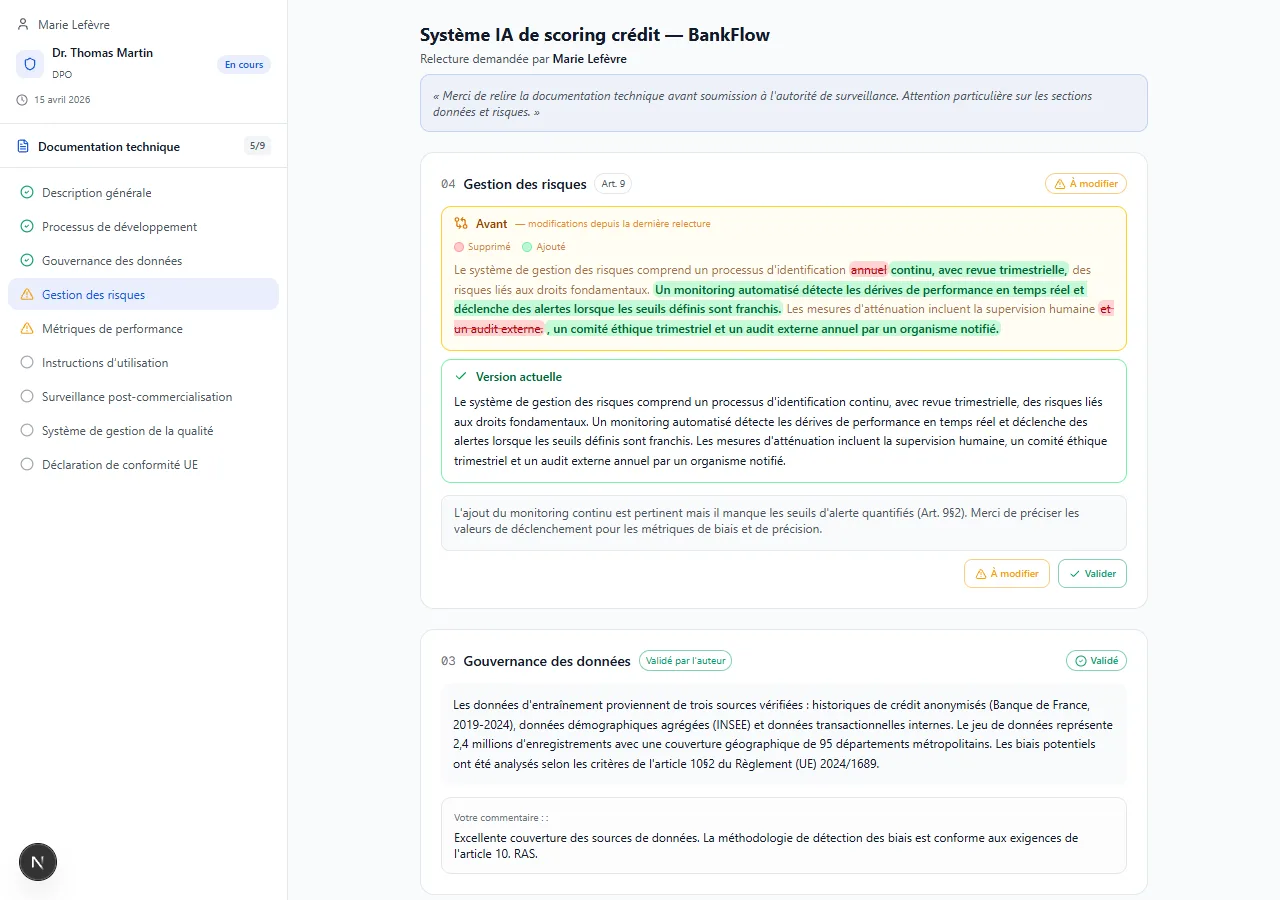
Before / After
Discover how collaborative review simplifies your validation process.
Without review workflow
- File exchanges by email with conflicting versions
- Comments lost in discussion threads
- No visibility on the validation status of each section
- Impossible to prove the validation process to auditors
With AiActo
- Reviewers invited with targeted access per section
- Contextual comments directly on each field
- Tracking dashboard: approved, pending, rejected
- Complete validation history for audit
Without review workflow
- File exchanges by email with conflicting versions
- Comments lost in discussion threads
- No visibility on the validation status of each section
- Impossible to prove the validation process to auditors
With AiActo
- Reviewers invited with targeted access per section
- Contextual comments directly on each field
- Tracking dashboard: approved, pending, rejected
- Complete validation history for audit
How it works
Step 1
Inviting reviewers
Invite your experts by email with a reviewer role. Assign them specific sections to validate based on their area of expertise.
Step 2
Contextual review
Reviewers access a dedicated view with the regulatory context for each field. They add comments directly on the sections that need changes.
Step 3
Validation tracking
Track the status of each section in real time: pending, commented, approved, or rejected. Identify blockers at a glance.
Step 4
Final approval
Once all sections are validated, the final approval triggers version locking. The validation history is preserved for audit.
Key benefits
Collaborative review structures your document validation process.
Art. 17 Compliance
The quality system requires a verification and validation process. The review module provides documented proof of this process.
Targeted expertise
Each reviewer only sees the sections relevant to them. The lawyer validates regulatory aspects, the engineer validates technical specifications.
Complete traceability
Every comment, approval, and rejection is timestamped and attributed. An indisputable audit trail for your compliance.
Accelerated review cycles
Reviewers work in parallel, not sequentially. Contextual comments avoid email back-and-forth.
Approach comparison
Collaborative review vs alternative methods.
| Email / Word | RecommendedAiActo | Generic review tool | |
|---|---|---|---|
| Comments | Separate email | On each field | Per document |
| Status tracking | Non-existent | Per section | Global |
| AI Act context | Absent | Built into each field | Absent |
| Parallel review | Conflicts | Multi-reviewer | Possible |
| Audit trail | None | Complete | Partial |
| Targeted access | All or nothing | Per section | Per document |
| Try for free |
Frequently asked questions
From your assessment, click 'Invite a reviewer' and enter their email address. They will receive a direct access link to the review view with their assigned sections.
No, you can limit each reviewer's access to specific sections. A lawyer may only see the regulatory section, while an engineer sees the technical specifications.
Comments are attached directly to the relevant field with regulatory context. The editor sees each comment in context and can respond or apply the suggested change.
Yes, a dashboard displays the status of each section: awaiting review, commented, approved, or rejected. You instantly identify blockers.
Yes, every validation action (comment, approval, rejection) is timestamped and attributed to its author. This history constitutes proof of your quality process for auditors.
Yes, when final approval is given, the version is automatically locked. If changes are made after approval, a new review cycle can be triggered.
Structure your validation process
Organize the review of your technical documentation by your experts with structured and traceable workflows.